

What is imposter syndrome? A quick googling of the term would bring up a definition from the Harvard Business Review; this is “a collection of feelings of inadequacy that persist despite evident success”. So where do these feelings come from and how can we deal with them and cure our imposter syndrome?
Being a scientific minded person, I have a desire to define things differently, to uncover a formula which causes these feelings. Through careful consideration we can uncover this formula and use it to help us deal with these feelings, ultimately improving our wellbeing and therefore our lives.
In order to uncover this formula we need to answer 6 key questions;
1. Who suffers from imposter syndrome?
Often imposter syndrome is suffered by people who are in a new environment, be this a new place of work, a new position at work or a changed working environment. This can be anybody, and ultimately it is triggered within people due to an anxiety surrounding a change.
2. What is imposter syndrome?
We have seen that it is defined as a collection of feelings of inadequacy. Inadequacy comes from our deep rooted desire for social interactions, the need for status among our social group and to feel a sense of self-worth. We have a desire to feel needed, to be useful and wanted within the social circle we reside; to feel respected.
The types of social interactions we experience provide us with one of two key feeders; confirmation or affirmation. Confirmation being an external signal which reinforces an inner belief, while affirmation is an external message which validates an inner thought or feeling. When we experience these, they speak to our inner voice and this is how we measure our self-worth and build our self-confidence.
The feelings of inadequacy which feed imposter syndrome come from either a lack of reaffirming social interactions, or a misreading of these social interactions. The inability to recognise signs that we are valued by our social group and hold status within the group can easily arise from our own perception of self. In other words positive signs could be there, but we may not recognise them, and we could instead be the cause of our own negative signs. This is a feedback loop is known as the Pygmalion Effect;
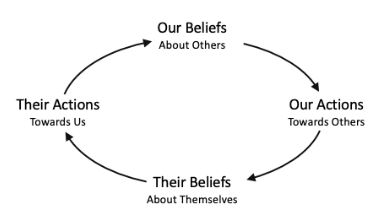
If we start at the bottom, this is our perception of self; how we view ourselves. If we hold a negative perception, then what will happen is this will feed into the way which we socially interact with others people. Therefore the way we come across will portray our self-worth and inadvertently feed into the perception they hold of us. They may have held a higher view of us, but through the interactions which we have had with them, they start to believe what we believe. Ultimately this will influence the way which they interact with us, they stop giving you the positive signs and start feeding into and reaffirming the negative view which we held about ourselves initially.
3. When do we experience imposter syndrome?
We as a species are more often than not fearful of change, particularly from an environment where we once felt comfortable and secure. Our response to change is often similar to our response to loss. Therefore we can see where the feelings of inadequacy arise by adapting the grief cycle to represent our response to change.
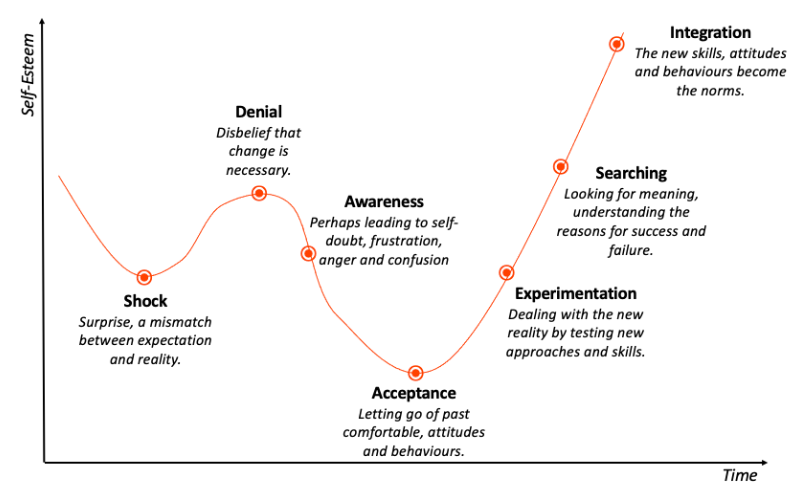
We can see that when change occurs there is a sudden loss of self-esteem which is met with shock. The change in role, responsibility, environment, etc. they all cause a shock at some point. This is where we are met with a challenge which we are not yet ready for. Our first response is of course denial; we refuse the change, be it within ourselves or our environment as change is difficult and challenging and we prefer what is easy and comfortable. Where insecurity comes in is the next stage; awareness. This is an awareness of our inadequacy at the time to face this change; the challenge which we are faced with. The self-doubt and realisation of our lack of experience or skill provides a huge barrier mentally in our mind.
The feelings of inadequacy are natural, and actually they are necessary as they are a key indicator of self-awareness. Here, in this space between awareness and acceptance lies imposter syndrome!
5. Where do we experience imposter syndrome?
This holds two answers; internal and external. Internally, we hold our feelings of inadequacy within our Limbic System. This is the part of the brain which is responsible for our feelings and emotions. Most importantly, this part of the brain is responsible for behaviours and decision making but has no capacity for language. This part of the brain gives us our “gut feeling” and we find it incredibly hard to put into words what it is we are feeling and why. Often, when we feel inadequate we are unable to get to the root cause of these feelings, and instead we look to use our Neocortex, the rational part of the brain where language exists to rationalise our feelings and why we feel the way we do; we look for external signs for justifications as to the internal feelings which we hold.
Externally, our feelings for inadequacy arise from the environmental cues which surrounds us when we are in an environment which is alien to us. In other words, an environment where we do not feel relaxed, comfortable and ultimately an integral part of. Therefore, this is a new environment for us; either because of a change to the role itself, the responsibilities we have, the personnel we are surrounded by, the infrastructure of the environment or a combination of these.
We have likely all experienced the feeling we get in our gut when we walk into a new place; be it looking at new houses or going for a job interview. We walk in and there is an immediate gut response to the environment, sometimes this feeling is positive and we say “it just feels right” and other times we get that feeling that “something is off”. There are times when that first interaction with someone there can settle this feeling and we start to feel comfortable, but other times it persists.
If we continue to stay in a place where this gut feeling persists, it can give us a sense of displacement; a feeling of not belonging. As a social species, belonging is key to happiness, this can be seen in Maslow’s Hierarchy of needs;
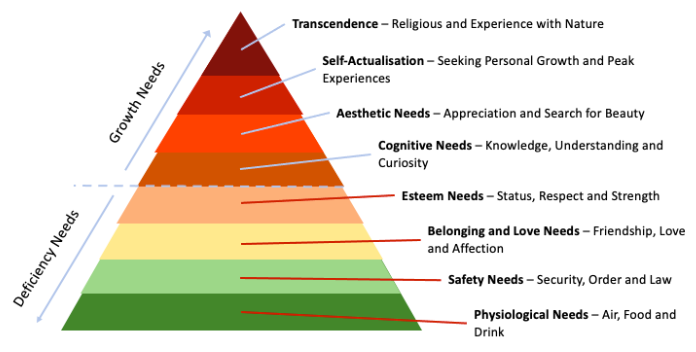
Within this hierarchy, in order to sustain our level of self-worth, happiness and physical wellbeing we need to hit and maintain the four ‘deficiency needs’. The third and fourth of these are belonging and esteem. Therefore our self-esteem can only be maintained and built upon when we have a sense of belonging; that inner gut feeling which tells us we are valued and wanted by those around us, and that we are in the “right place”.
5. Why do we suffer from imposter syndrome?
Having explored the previous four questions; the Who, What, When and Where, we can start to develop a picture of the root causes behind imposter syndrome. This also reveals the formula which leads to extreme, persistent feelings of inadequacies which leads to it;

What this formula tells us is that internal security comes from a fine-tunes balance between the position which we hold within our social group, the ability we have to perform this role and our experience in performing it.
If we hold a position which comes with a clearly defined set of responsibilities, we are trained and have the ability to perform these and have the experience of doing so, we feel secure within ourselves. However, if we hold a position where either our ability or our experience is lacking, or worse both, we will find ourselves feeling insecure within ourselves. Feelings of insecurity leads to a state of shock which will develop feelings of self-doubt and inadequacy. Which when not checked and acknowledged will lead to imposter syndrome which can impact upon our overall wellbeing and self-worth.
6. How can we deal with imposter syndrome?
Ultimately our journey throughout life will come with career progression, changes of jobs and job roles and promotions. These are necessary to progress and meet our higher “growth needs” within Maslow’s Hierarchy of Needs and also improve our social status which is necessary for our evolving measure of self-worth.
Therefore, the position element will always be changing and we will be faced with shocks, denial and an internal awareness of our deficiencies. The deficiencies will come as either a lack of current ability or a lack of previous experience. Therefore, we will undoubtedly experience insecurity, and this is not only good but necessary.
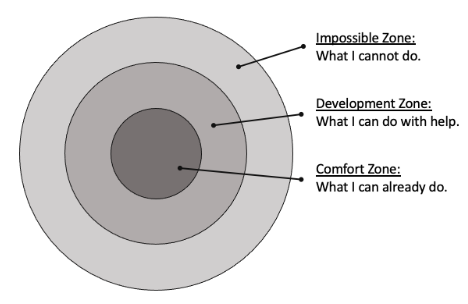
Ultimately what has happened is we have moved within Vygotsky’s model from the centre, our “comfort zone” to one of the two outer circles. This is either the “development zone” where we currently have the ability but not the experience, or the “impossible zone” where we currently don’t have the ability or the experience.
So what can we do to address these feelings of inadequacy and deal with the imposter syndrome? This requires us to reach the next step, this is an internal switch and requires us to reflect upon ourself and reach acceptance. We must face our current deficiencies as that, “current”, and acknowledge that we are able to grow and develop;
- If we lack experience, we can seek out opportunities to gain experience, we can open up avenues of communication with others who have experience and ultimately find ourselves a mentor or coach who can guide us towards experience.
- If we lack ability, we can again seek out opportunities to learn new knowledge and skills. This requires communication and being open to learning from others who already possess the knowledge and skills which you need; find yourself a coach or mentor who can teach you.
There is one key take-away; it is a good thing to feel insecure within your current position. However, you must pause and reflect and realise that this feeling of insecurity can be temporary if you are willing to be honest with yourself. You are feeling insecure because you have taken an opportunity to progress your career along the path, or even changed path completely. Therefore you may well find that you currently lack certain abilities or experiences, but these are both things which can be addressed with intentionality. You must accept your current deficiencies and seek out opportunities to address them by communicating and being open to help from others.
Nobody is the complete article, everyone has feelings of insecurity, this comes from an ever-changing environment in a rapidly changing world. When we take time to pause and reflect on where our current deficiencies lie, we take the first step between awareness and acceptance. We can then intentionally take action to address these which is the key hurdle to overcome in raising our self-esteem, which will improve not only what we believe about ourselves but the beliefs others have of us and our interactions. This addresses our imposter syndrome and ultimately improves our own wellbeing.
Christopher Waters
Founder of LAMDA Solutions
1 thought on “Imposter Syndrome – An Exploration”