
Advice Given to Teachers at the Start of Term – Part 2
It’s September, and as students settle back into schools across the country, there’s another group of individuals feeling the weight of the new academic year: the teachers.
For many, this new school year represents the beginning of a fresh chapter: new schools, new positions, or simply another chance to make a difference. But alongside this renewed sense of purpose comes a familiar anxiety for some, one tied to the looming challenges and high expectations that lie ahead.

After just the first week back, a few teachers reached out for advice and support on various issues. In the second of three blogs connected to the start of the academic year, I’m sharing the guidance I offered to one teacher who was already questioning if they should leave the profession, and the steps we took to help them figure out their “am I sure?”
Thinking about leaving the profession already…but am I sure?
Context:
This teacher has been in the profession for a few years and has considered leaving a few times. However, the fear of change and being unsure what else is out there has kept them in the profession and moving around from school to school. They have been in their new school for just over a week and already they’re regretting their decision of starting at a new school, yet they are concerned about how they will (a) be seen, (b) be treated, and (c) come across to a potential new employer, if they were to hand in their notice only a week into their new school.
The Advice:
First and foremost, I felt it important to explore the position they are currently in. Their current setting and reality are important to gain a handle on. Only being a week into their new position it is likely that their past experiences are driving their feelings about their current setting. There are many commonalities and situations which different schools have in common, these could be a trigger point for someone regularly moving around, looking to find a school in which they feel comfortable.
As a result of this, it was important to reiterate at this point, that any change is a big thing, and something which we are all fearful of. To this point, the change which this person has been putting themselves through has not entirely been the big change they are now considering and have been for some time. They have stepped back at several points over the last few years from making this big leap, instead they have made small sideways steps within their ‘comfort zone’.
Comfort is just that, comfortable. We as a species like comfort…we know how it works, what it looks, sounds, and tastes like. It is familiar to us and as such requires less thought and effort to commit to. We know how to deal with it, and we form habits and shortcuts around this familiarity which allows us to function with little intentional thought. So, both big and small changes come as a shock to the system and we all recoil at them.
With this particular situation, the regular moving around within their comfort zone seems to be an avoidance of the big change they were initially looking for several years ago. However, without the clarity around that next big move, they have instead entered a cycle of small sideways moves which has led them to become uncomfortable within their comfort zone.
So, the next exploration I felt important to take was that of our response to change itself. This meant taking a look at the grief curve, or its adapted version ‘the change curve’. This is the process we all do when any change comes in (grief is the most extreme version of a change which can happen in our lives).
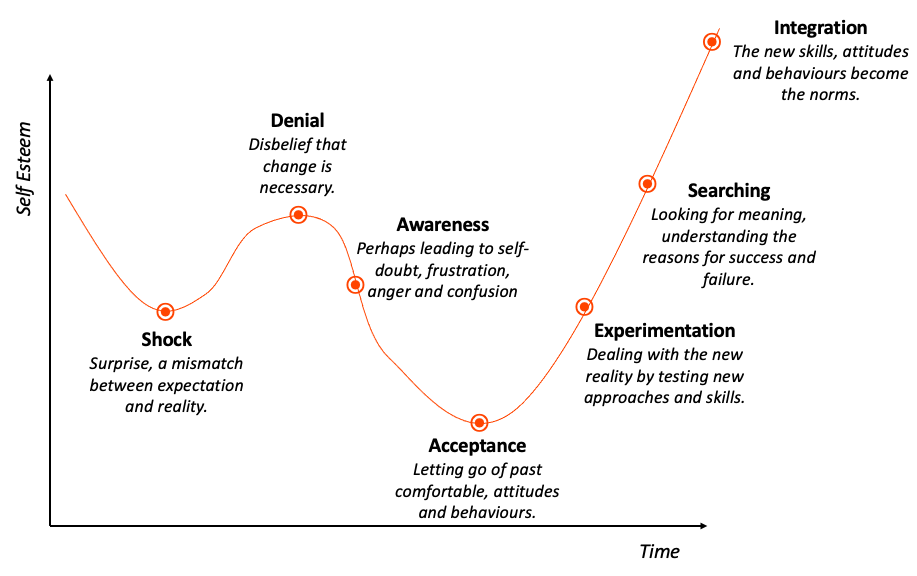
Those people who adapt to change quickly are the people who, in that context, move through the curve quickly and arrive at the experimental phase within a few seconds/minutes/hours. And for some people it takes days/weeks/years to move through this.
I felt it was worth having a thought about where on that cycle this person may in fact be. They were obviously not happy in their position a few years ago and considered the potential moves away from that situation. As a result they moved to somewhere new, seeking to re-find that (a) initial excitement they may have felt around teaching, or (b) a level of comfort within the profession utilising their skillset.
However, making this initial move did not find either of these quickly enough, and instead they sideways stepped again, and again…each time not finding what they may have been seeking. Each time, seemingly writing off a new place quicker and quicker, until getting to this point where only a week in and it seems they have made their judgement already.
So, before making any big leap or big decision around their current situation, I felt it important to share consider how long it would usually takes them, within a work setting to adjust to the changes, and move through this cycle towards the exciting experimental phase which is where an individual feels comfortable enough with the changes that they are able to experiment and explore the possibilities of staying within that setting.
Coinciding with this exploration, it was important to also explore how lots of changes, all in one go, which coincidentally becomes so apparent at the start of a new academic year at a new school, can make this process of accepting change much tougher. This was important to point out, as although they had considered leaving the profession multiple times over the last few years, it is important to ‘be careful on making big decisions in the midst of the mud’.
This analogy was a useful one to draw out. When you are there, stuck in the middle of a muddy field, getting rained on and wishing to be on a big sandy beach bathing in the sun. It is easy to forget that maybe you aren’t adapted for that sun either, maybe you are susceptible to sunburn and there on that glorious beach you may well get burnt. And instead, by thinking about how lovely that beach would be, you actually lost sight of why you were walking through this muddy field in the first place, that on the other side of this muddy field is a wonderful view, and that the rain is going to clear away in an hour, and you’ll get to see it!
The point of the analogy is, that a large part of the change curve is the trough itself. The hard times, the tough parts, the questioning, the resistance to the change, and ultimately the ‘seeing this part through’, is the proof we all need to show ourselves how resilient we are, how strong we are, and how capable we are of adapting to changes when we face them.
The Action:
Having explored the journey to this point over the last few years, through the lens of change, I felt it important to provide a reflective tool for them to utilise to really gain a perspective of their situation.
The Rationale:
It is important not to make decisions at the right time, and not at the moment it is an emotionally driven response. It takes our head time to catch up with our heart and our gut. If we don’t give ourselves time to slow down and reflect on what is really driving us to seek something new, we can often find ourselves jumping out of the frying pan and into the fire.
The point at which we should be making decisions on our future is at the point of acceptance. It is easy to make a knee-jerk decision when we are within the denial or awareness phase, where we are still fighting and resisting the new setting, and the changes we are experiencing as a result.
Instead, at the acceptance phase we are starting to let go of past experiences and hang-ups from our previous settings, and coming to terms with what this new setting, and its associated changes, means for us. Only here can we truly make decisions on whether this setting can do for us what we were hoping for, or whether we in fact need a whole new set of changes and therefore setting: in this case a new profession.
Christopher Waters
Founder of LAMDA Solutions