
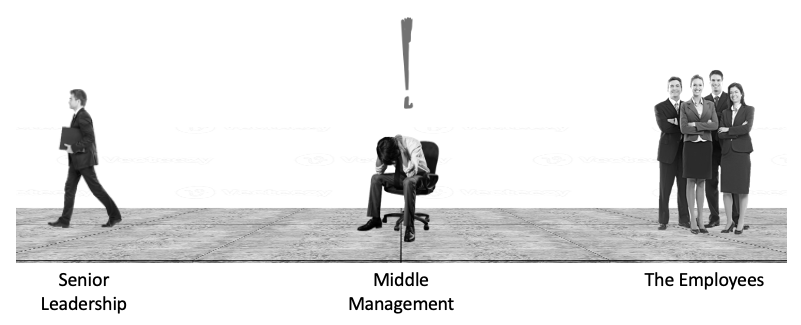
Often, within Middle Management positions we can find ourselves caught between our employees wants and needs and those of our superiors, and the organisation as a whole. So how can we navigate these challenging situations? How can we do best by those in our charge as well as “tow the party line”? How can we save face with each in order to maintain our kudos with the powers that be as well as retain the trust bestowed in us by the members of our teams?
Before we can lead effectively as Middle Management, we must first gain clarity over;
- Our position; what we are looking to achieve through the subsequent conversations.
- Our understanding; what we believe the wants and needs of both parties are. These are not wants and needs of us, but around the situation.
- Our responsibilities; what is expected of us. Here we should ask ourselves what each party wants and needs from us.
- Our role; what part we must play in this situation. It is important to stay true to our inner values, yet also be an impartial advocate for each party when in each discussion.
Ultimately our goal here is to bring each party closer towards the middle, from whatever opposing position they may have. We are acting as a reality check to senior leadership with respect to the “boots on the ground” while acting to lead your team within the umbrella of the organisation with you team themselves. You must be a leader, taking care of those in your charge, while taking them to places they never thought they could go on their own.
The best approach to achieve this then may seem common sense, but ultimately it may be difficult to follow through with. This approach is one that I call ‘centring’. This involves a careful balance of two conversations, two positions and ultimately carrying out our roles as Middle Management.
The First Conversation
With all conversations, and in particular leadership conversations where building and maintaining strong relationships is key, the order in which we speak and the tone we take are both vital. We ultimately are curating the discussion and steering it towards a more desirable outcome for all.
The first conversation we have should be with our superiors, those who represent the needs and wants of the organisation and are looking to uphold their values and vision.
1. Determine their wants and needs: in this instance we are looking to re-establish a common understanding of both the wants and needs of themselves and the organisation. This is looking to get them to lay out their desired outcome from the project or initiative, or even what their vision for the change they are looking to implement is. With this understanding you can be sure you know what the ultimate goal is, and can use their words as we move through the discussion.

2. Share your understanding of the situation: here the goal is to share what you have ‘heard’ from the team. We leave all names out of this, we are not dropping anyone in on this and we are making sure we are not placing ourselves into this. We are not saying that we feel this is what is happening etc, as this would place us as a member of the team in the eyes of our superiors, instead we want us to be seen as on their side; an advocate of the wants and needs of the organisation.

3. Find a Compromise: with this step there needs to be movement from both perspectives. You should look to express a view which aligns with the ultimate vision. However, you must suggest a compromise which allows for some of the wants and needs of your team whilst still being able to achieve the desired outcomes, at least partially at first.
In doing this step, you move yourself closer, in the eyes of the organisation and the senior leadership team, towards wanting to achieve the shared goals of the organisation and therefore they too will be more open to moving closer to the middle ground. The aim here is to bring yourselves together in order to collaborate on a solution, the closer you can become the more successful you could be in co-creating a solution which builds in some of the wants and needs of your team.

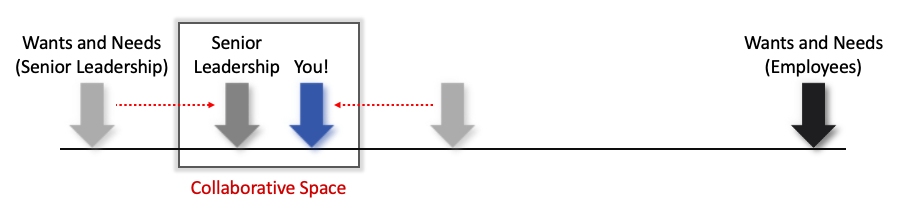
4. Agreed Actions: the final step of any co-creating stage must be a recap of the agreed outcome and action points which arose from the subsequent discussion where a compromise was found and the once and needs of both the organisation and your team members were considered.
Here in this final step it is important to make sure that accountability is placed where is most needed. Overarching, big picture decisions and actions must be taken by the senior leadership team. However, as a Middle Manager, your role and responsibility is always to communicate the outcome with your team, ultimately looking to get buy-in from them.
The Second Conversation
Only once the first conversation has been had can you return to your team and have a constructive discussion. Without the first discussion taking place, all you will achieve is a circular discussion where the same points are raised and gone over again and again. If this occurring, it is likely because you have not full of through on your leadership responsibilities as Middle Management.
The discussion which takes place with your team will follow a very similar structure. The only part which would be different would be the opening; you would have already established the wants and needs through previous discussions which is what led to the first discussion with senior leadership.
1. Recap of Wants and Needs: here you will guide the discussion with very specific questions such as; “can you remind me of what our desired outcome for … was”. By being very guided, yet re-establishing the wants and needs around specific topics, you are able to once again create a trusting environment where your team will feel heard and reminds them that you are an advocate for their wants and needs.

2. Relaying of Organisational Expectations: within this section of the conversation it is important that you do not say that this is your expectations, instead what you are looking to achieve is the relaying in other words ” senior leadership are expecting or wanting us to…”. Through this stance, you do not place yourself in the eyes of your team as being a member of the senior leadership. You are not the person who is asking, or setting these expectations, and therefore they see you still as an advocate for their side, there wants and needs.

3. Establishing the Compromise: this part of the discussion is important, as this is where you lay out the compromise which senior leadership were willing to come to, with your assistance. By doing this you are able to sell to your team the decreased expectations, or slight movement towards their position which the senior leadership were willing to do. This provides your team with a small win and you are able to place yourself closer to them, bringing yourselves together in order to get their buy-in towards what the senior leadership were willing to compromise on.

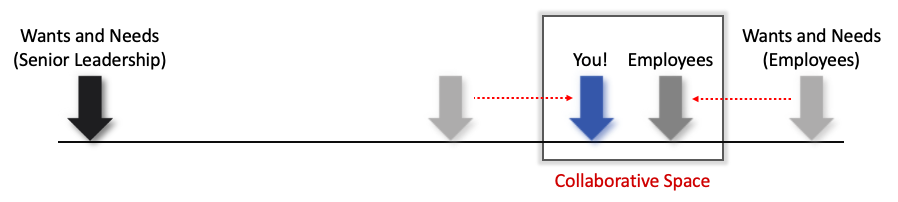
4. Agreed Actions: The final part of this discussion has to be agreeing actions and steps which are going to be taken by your team as you move forwards. Here, you close the deal by suggesting that if you are able to be successful as a team in this compromise, that they may be willing to compromise further in the future.
It is important to note here that you do not make any promises which you cannot keep. Use language such as may/might/potentially.
The above technique is a variation of a negotiation tactic, this works in the following frame which is similar to a classic conversation; there are two participants, two directions, and we are equally taking the centre stage in order to meet each other in the middle ground. Both parties; the person you are speaking to and the party you are representing are both being seen to compromise.
- They speak.
- Then you.
- Then you lead the compromise.
- They agree to the compromise.
- You lay out your actions.
- They agree to their actions.
Throughout this process you are taking a coaching style of leadership; both upwards and downwards. You are facilitating and leading, and when it is there turn, you are asking open questions around the area you are looking for responses on and creating the space for open and honest dialogue.
While the previous diagrams show two extreme views, at different ends of a spectrum, it is important to understand the distance between the senior leadership and the members of your team may be vast, or small. However, the same technique works regardless of the distance between.
This is because you are working as a mediator between the two. In doing so, you are in fact bringing the two sides together, and finding a form of common ground between the two. The ultimate hope here is that at some point, in a perfect world, the two sides will meet each other in the middle.
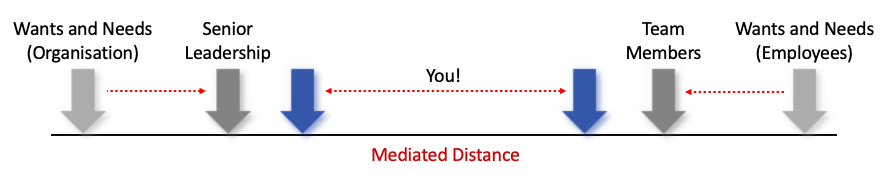
However, we all know that the wants and needs of the organisation will never in truth align perfectly with the wants and needs of the employees. As such, the ‘Middle Management’ role is one of the most challenging, as this role is there to work to bring together the levels above and below.
At each layer within an organisation this balancing act is taking place, and in reality the skill-set needed is a people centred skill-set and should therefore should be considered more of a ‘Middle Leadership’ role where leadership skills are imperative and training around these skills should be invested in!
Christopher Waters
Founder of LAMDA Solutions
Awesome read. Thank you for the sharing. I have not come across this kind of approach displayed in this content, yet. My informal training has also been of observation and was feeling lost when I started my new role in leadership. I came across the content in LinkedIn and because of my interest in understanding this “middle management” concept, I landed here. I am my wiser than yesterday and hungry to Learn today.