
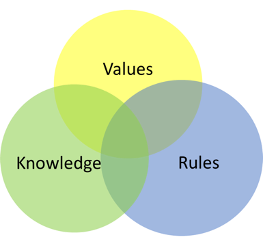
I ran a workshop recently, it was a very thought-provoking activity, and it got me thinking about the importance of shared values and structures within organisations. You yourself may have done this activity in an organisational development workshop; it is called The Baron’s Tale.
The process is as follows, you hear the following story:
“This is the story of a Baron and a Baroness who lived together in a spacious castle. One day, the Baron said to the Baroness: “I’m going out for the day and will be back late. While I’m away you must not leave the castle for any reason whatsoever. If you do you will be in extremely serious trouble.”
After some time, the Baroness became bored, so she left the castle and went to her Lover’s house. After some time, she awoke and realised it was getting late. She ran back to the castle and was just crossing drawbridge when the Gatekeeper jumped out in front of her brandishing a sword.
“Stop!” he cried. “The Baron has told me that if I was to find you coming back into the castle today I was to kill you.”
With that, she shrieked; ran back to the Lover’s house and begged for help.
The Lower said “I’m sorry, but it’s your own fault. If I help you, he will kill me as well. So clear off!”
The Baroness went back towards the castle and noticed a Boatman on the moat. She had an idea and asked the Boatman: “Would you row me to the back entrance to the castle so that I can get in?”
“Gladly, my lady” he said, “but it will cost you £6.”
“I have no money with me at the moment” she said, “but if you take me over, I can go in and get some.”
“Oh, I’m sorry my lady” he said, “but it’s money up front or no crossing.”
So she went to see a Friend and asked to borrow the money.
“No, I’m sorry” said the Friend, “If I do, your husband will kill me too.”
By now it was getting late, and the Baroness was getting desperate.
She returned to the drawbridge and there was no one around.
She decided to rush across, and, just as she thought she was home and dry, the Gatekeeper jumped out and ran her through with his sword.“
Upon hearing this a first time, each participant is asked to individually rank the 6 characters in the story in order of their level of responsibility for the death of the Baroness.
Why not try this now:
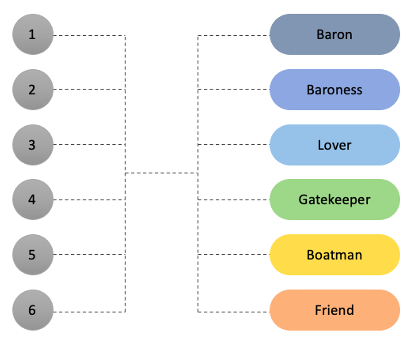
Then breaking into small groups, participants must come to an agreed Consensus on their order, before these are collected in and shared anonymously with the group. An example may be:
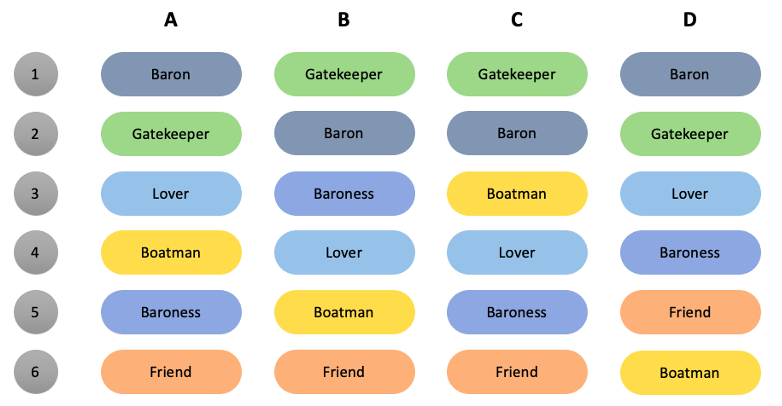
Then comes the discussion and debate around why our orders may well be so different. And I am sure you yourself might well have a different order than the ones above.
So why are the orders so different? The simple answer is that it is because we don’t really know the rules of the game. We all have our own personal values, and the values we hold personally determine in some respect the order which we choose for this when we are writing our own personal order.
There are then some external factors such as social conformity which comes in to play knowing we will be sharing our orders with a select few in the group, and as such we may bend some of our own personal values in favour of those which we believe are common to the group we may be sharing with. When it comes to then discussing and justifying our choices within our small group, we often find ourselves also looking to defend our choices, which may involve invoking some element of inferring about the story; adding in additional unknown elements which could come in to play which support our order.
All of this is a fascinating exploration of social psychology. However, there is a more fundamental message which we are looking to unveil here, and it comes to discussing and agreeing on a set of shared values which we all agree to follow. This discussion itself opens a large amount of debate, as the group comes to terms with having to fit their values and opinions into that of the group; having to meet somewhere in the middle or accept that what we consider a hard line, or an absolute may in fact need nuancing for us all to agree. Thus comes the art of negotiation and diplomacy.
In the group I recently delivered this to, we ended up drawing together only 5 rules or values which we would then use to re-decide upon our order, these were:
- In we have the capacity to help (without putting ourselves in danger), we should.
- Intention matters.
- The amount of knowledge correlates with the amount of responsibility.
- It doesn’t remove responsibility even if you didn’t do the act if you have enforced the act.
- You are responsible for your own actions, within reason.
You can see from the groups set of rules, there are some nuanced elements, such as the use of “without putting ourselves in danger” and “within reason”. There was also a large amount of discussion and debate around the word to use for the fourth rule, “enforced” as to whether it should be “empowered” or even potentially “enabled”.
Having agreed on this, we revisited the story and explored each character in terms of each of our 5 ‘rules’. This still proved challenging, however enforcing the importance of only deciding based on the things we know; the evidence within the story, allows for a consensus to be met on the order. With this group this meant ultimately putting the Baron as number 1 and the Gatekeeper as number 2. Yet with every group the order is always different as the shared values by which we determine the final order is always different.
So how does this relate to organisations?
In any organisation or group of people, there needs to be values, rules, and structures to follow. This needs to be both shared and bought in to. When this is in place, it provides a clear framework and set of rules by which the actions within the organisation can be taken and judged upon. Without these, there is room for both interpretation and misunderstandings to occur, which if unchecked can lead to difficult situations and decision needing to be made.
It is highly unlikely to be a situation like the one above, and the values and rules which are decided upon are also unlikely to be those which I listed above. However, there will need to be a set of core values which the organisation, and the people within, it stands for. There will also need to be clear checks and balances in place, clearly defined procedures for certain tasks and processes which must be followed. And finally, these must be regularly reviewed to see if they remain ‘fit for purpose’ as well as whether they still reflect the organisation and the people within it.
When the rules of the game are clear, when they are shared and agreed upon, reinforced and the reasons why made clear, then a consensus within the organisation is made and everyone knows and has bought in to these shared values, and they will live by them!
Christopher Waters
Founder of LAMDA Solutions