

How do we learn, develop and grow? In the ever-evolving landscape of leadership, one timeless truth remains: growth is the compass that guides us towards success. Most of us are keen to grow, and we set ourselves targets which require growth, but many of us struggle with achieving effective growth. So, what are the barriers we face, and are there things we are doing which actually impairs growth and limit our potential?
I recently heard a quote from James Clear (the author of the best-selling book, Atomic Habits) which has stuck with me; “You don’t rise to the level of your goals, you sink to the levels of your systems.” This got me thinking about the enigma of growth and its reliance upon our motivation and a desire for mastery. At LAMDA Solutions, we are passionate about not just understanding these concepts, but also the path that leads aspiring leaders to unlock their true potential. Join us as we delve into the heart of growth, decode the art of mastery, and uncover the secret ingredients that fuels unwavering motivation.
Every successful leader, be it within business, academia, or the arts, shares a common origin story: the pursuit of growth. The allure of constant progression, of refining one’s skills, and of seeking new horizons has propelled luminaries throughout history to remarkable heights. But what truly constitutes this elusive growth? Is it merely a culmination of the hours invested, or does it involve a deeper, more intricate dance between dedication and inspiration? In this exploration, we shall dissect the very essence of growth, sifting through the components that pave the way for an individual’s ascent.
Motivation alone is but the fertile soil from which the blossoms of growth and mastery emerge. Imagine a symphony where each note, meticulously crafted, contributes to a harmonious whole. Such is the interplay between mastering one’s craft and nurturing an unwavering source of motivation. Our journey will guide you through the pursuit of honing your skills and the profound motivation that arises from finding purpose and meaning in your craft.
As we embark on this exploration, we shall answer a series of questions to uncover a deeper understanding of the topic.
1. Who achieves effective growth?
In the realm of leadership and personal development, growth is a continual process of learning new knowledge, skills, capabilities and mindset in order to become a more effective and impactful leader. Aiming to enhance not only technical competencies but also our emotional intelligence, self-awareness, and the ability to inspire and lead others. For true growth to occur, one must also implement this new knowledge, skills, capabilities within their practice in order to nurture our working relationships and improve the level of influence we have.
Anyone is capable of effective growth, however an easy example of a type of person who achieves effective growth which we would all know would be a world-class athlete. These individuals are often looked up to in awe, and at times proclaimed as being ‘naturally gifted’ or somehow having some ‘god given talent’. However, somewhere deep down we know that what we are seeing is the tip of the iceberg, the culmination of a process which we have not been privy to.

2. What is it these people do which allows effective growth?
These individuals who have reached the top of their respective field, who have ‘perfected the growth-game’ have done so through purposeful practice. In the 2010 book Bounce by Matthew Syed, he says “Top performers aren’t born, they’re made. They’re made by the circumstances they find around them and the cultures that they grew up in.” Here, he has hinted at the idea of a process ‘making’ these elite individuals, the belly of the beast, the bulk of the proverbial iceberg which hides underneath the surface.

Matthew Syed explores the idea that elite individuals are able to reach the levels of exceptional performance which they do, as a result of ‘purposeful practice’. He challenges the popular notion of the 10,000-hour rule, that practicing the skill you wish to master for 10,000 hours would lead to this elite level; the mastery of the skill. Syed introduces us to what I will call ‘the three pillars of purposeful practice’.
- The quality of the practice.
- The nature of the practice.
- The quantity of the practice.
With purposeful practice one is able to work towards, and potentially achieve what we call ‘mastery’. So, what is mastery? Mastery refers to the highest level of proficiency, expertise, and skill in a particular area or discipline. It goes beyond basic competence and involves a deep understanding, refinement, and application of knowledge and abilities. Within the realm of leadership, achieving mastery would signify a comprehensive grasp over the relevant content (both existing and new, evolving developments), enabling the leader to navigate unforeseen challenges, innovate, and solve complex problems with a high degree of confidence and creativity.
Mastery within leadership is characterised by consistent and exceptional performance, a keen ability to adapt and problem-solve, and the capacity to impart knowledge to others effectively. This is a lifelong pursuit that involves continuous learning, deliberate practice, and a commitment to honing one’s craft to the point of exceptional proficiency and insight. Reaching mastery therefore requires a commitment to consistent growth, as without this, what once was mastery would soon diminish in this ever-changing practice.
3. When do we experience growth?
In the 2009 book Drive: The Surprising Truth About What Motivates Us by Daniel H. Pink, he surmises that the motivation to improve and grow is fuelled by the innate human desire for mastery. It is a fundamental aspect of human nature to pursue growth and improvements within tasks which challenge them and allow them to develop their abilities. The mechanism which drives this is our intrinsic motivation; our internal mechanism which motivates us without the need for any external motivators.
Intrinsic motivation refers to the internal drive and inherent satisfaction that individuals experience when engaging in an activity for its own sake. It arises from a genuine interest, enjoyment, or personal value associated with the task itself. Intrinsic motivation is characterised by a sense of autonomy, curiosity, and the desire to master a skill or accomplish a goal because it aligns with one’s personal interests or values. Individuals driven by intrinsic motivation find fulfilment in the process of learning and growing, often seeking challenges and investing effort with enthusiasm.
Extrinsic motivation, on the other hand, involves engaging in an activity or pursuing a goal primarily to attain external rewards or avoid punishments. These rewards can include tangible outcomes like money, recognition, or status, as well as intangible factors like praise or approval from others. Extrinsic motivation may lead individuals to complete tasks, but it is often tied to the external incentives rather than a genuine interest or passion for the activity itself.
Within leadership development and the pursuit of mastery, the interplay between intrinsic and extrinsic motivation is crucial. Effective leaders understand the importance of fostering intrinsic motivation both within themselves and their leadership development, as well as their teams. They create environments that encourage autonomy, provide opportunities for skill development, and emphasise meaningful work. By aligning tasks with personal interests and values, leaders can inspire intrinsic motivation, resulting in greater engagement, creativity, and a sense of ownership among team members.
Mastery is often driven by intrinsic motivation. Those who are passionate about a particular skill or domain are more likely to invest the deliberate practice and effort necessary to achieve mastery. Intrinsic motivation fuels the desire to excel, embrace challenges, and continuously refine one’s abilities. Leaders who embody intrinsic motivation serve as role models for their teams, inspiring them to pursue mastery by demonstrating the joy and fulfilment that comes from personal growth and skill enhancement.
While intrinsic motivation is a powerful force, extrinsic motivators can also play a role in leadership development and mastery. Effective leaders recognise the importance of providing meaningful external rewards and recognition to acknowledge achievements and encourage progress. When aligned with intrinsic motives, extrinsic rewards can reinforce positive behaviour and contribute to a holistic approach to motivation. Understanding the dynamics of intrinsic and extrinsic motivation offers leaders insights into how to nurture their own growth, inspire their teams, and foster a culture of continuous improvement. By tapping into intrinsic motivation, leaders can fuel the pursuit of mastery and guide their teams toward achieving exceptional results and personal fulfilment.
4. Where is growth achieved?
In order to tap into this powerful pot of intrinsic motivation, we need to build an environment which encourages challenge and development, fostering a passion for related growth. Passion can be linked closely with having a sense of purpose and autonomy in what we are doing, alongside the recognition of progress being made. These three are integral pillars that come together to contribute to sustaining high levels of motivation. When an individual finds purpose in their work, a meaningful connection is established between their tasks and a larger, impactful goal. This sense of purpose instils their efforts with a deeper significance, fostering a profound intrinsic motivation to contribute meaningfully.
As well as this, when an individual feels a sense of autonomy, it empowers them to make decisions, exercise creativity, and take ownership of their responsibilities. Autonomy not only nurtures a sense of control but also taps into the innate desire for self-direction, igniting a self-propelled motivation that fuels enthusiasm and engagement. Couple purpose and autonomy with a clear sense of progress, a knowledge that efforts are leading to tangible advancements, and a powerful combination emerges. The incremental achievements and milestones not only reinforce a sense of accomplishment but also provide a roadmap for growth.
So how can this be achieved? A theory which has provided fruitful approaches to this comes from the work of Psychologist Mihaly Csikszentmihalyi in his theory of flow states. This theory can be summarised within the following graph.

Within this theory lies many states, one of which is the flow state; when the current level of skill matches the level of challenge. This state is characterised by an immersive state when one experiences unwavering focus and an energised state where time seems to slip away. The other key terms speak for themselves; for example, when the challenge is far too high compared to the current skill level this leads to anxiety while an individual would feel relaxed if their skill level was very high compared to the level of challenge.
In our exploration of growth, we can see that there are three key states which we need to consider; Arousal, Control and of course Flow. In a process of growth, one must first achieve the state of arousal, this is where the level of challenge exceeds the current level of ability within whatever we are looking to learn. If the challenge is too far beyond the current level of ability, then we reach anxiety which is detrimental to growth.
If we embrace this state of arousal, and we put effort into improving our ability level through knowledge and skill acquisition, then we can improve ourselves into the flow state. However, we cannot rest in our laurels here as with increased time, the level of perceived challenge becomes too low for us, and we slip into the control state. Any further and we relax, and we get left behind by developments in the real world. So, what arises is a pathway for growth from this model which we can draw on the following graph.

We need to consider how we can remain in the arousal state, in order to achieve continued growth and reach the flow state. The potential answer here comes from the work of Dr Carol Dweck in 2000 with her theory of mindsets which lead to the theory of growth mindset. The impact of a growth mindset on motivation is profound, as it lays the foundation for resilience and the ability to navigate setbacks with unwavering determination. But what is a growth mindset and how can one achieve it?
A growth mindset is characterised by the belief that abilities can be developed through effort and learning, and it fosters a sense of optimism and curiosity. When individuals embrace this mindset, challenges are seen not as obstacles but as opportunities to learn and improve. This perspective fuels intrinsic motivation by nurturing a hunger for knowledge and skill enhancement; growth.
Setbacks will inevitably arise, and as they do, a growth mindset acts as a shield against discouragement, enabling individuals to bounce back with resilience. This resilience, in turn, paves the way for achieving a state of flow. As a result, the pursuit of mastery becomes a continuous cycle where setbacks become a sequence of steppingstones and an individual’s resilience propels their progress, and their joy of learning then fuels their motivation to keep pushing their boundaries.
However, developing a growth mindset is a transformative journey that requires intentional effort and a commitment to continuous improvement. Central to this journey are strategies like deliberate practice and the courage to venture beyond your comfort zone into the zone of proximal development.
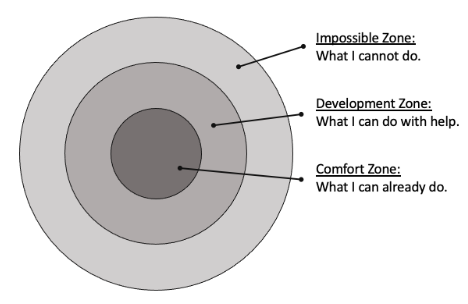
Deliberate practice is a systematic approach to honing skills, characterised by focused, purposeful, and structured efforts. It involves breaking down complex tasks into manageable components, pinpointing areas that need improvement, and dedicating concentrated time to practice. This strategic approach encourages a growth mindset by emphasising that one’s abilities are not fixed and instead can be refined through persistent and deliberate effort. The deliberate practice process, though often demanding, is where the transformational magic happens. It pushes boundaries, stretches abilities, and gradually shapes you into an expert in your chosen area.
Often this is hard to do on your own, particularly within the realm of leadership which is very much dependant on others and your relationship with them. It is therefore important to have support mechanisms, one important mechanism being that of feedback. Feedback acts as the compass that guides you towards a growth mindset within your leadership development journey.

Constructive feedback provides invaluable insights into your strengths, weaknesses, and areas for improvement. However, it is important to note that embracing feedback requires both humility and a recognition that every piece of input, whether positive or critical, is an opportunity for growth.
Actively seeking feedback and embracing it as a tool for refinement nurtures a growth mindset by highlighting that progress is achieved through iterative learning. Each adjustment based on feedback propels you closer to mastery, establishing a symbiotic relationship between effort, feedback, and growth.
Through feedback, you will constantly be pushing yourself out of your comfort zone, your safe haven. This uncharted territory beyond the comfort zone is where real growth resides. Stepping into this development zone, called the zone of proximal development, where challenges are slightly above your current abilities which we have seen is the arousal state. Embracing this zone of proximal development fuels a growth mindset by reinforcing the notion that progress occurs when one embraces discomfort, embraces challenges, and leverages them as catalysts for learning and advancement.
Developing a growth mindset is an ongoing feedback loop that intertwines effort, deliberate practice, and a willingness to push beyond familiar boundaries. It demands courage, persistence, and the recognition that the path to mastery is not linear but marked by progress and setbacks alike. Embracing this journey requires a commitment to the process, an unwavering belief in the development of abilities, and the understanding that a growth mindset is cultivated through the symbiotic dance of effort, practice, and feedback.
5. Why does growth happen here?
Change and growth are inexorably tied to our innate desire for progress and meaning. To explore this, we shall return to James Clear’s best-selling book ’Atomic Habits’ and look to combine this with Simon Sinek’s ‘Start with Why’ and Paul D. MacLean’s theory of the Triune model of the brain.
From considering these three ideas together, we find that the essence of change transcends mere action, rooted in the core of our motivations and habits. One needs to embrace change, shifting our very identity, through understanding the “why” behind our actions, we can break free from old patterns and form new habits that fuel our growth journey. Our “how” embodies the process of reshaping our habits, and the “what” becomes the tangible manifestation of our growth. In “Atomic Habits,” Clear unveils the power of identify-based habits as the linchpin of personal transformation, in doing so he illustrates that growth hinges on our ability to transform who we are at the fundamental level. These identity-based habits, where change occurs not just by altering what we do, our habits, but by redefining who we believe we are, our identity.

By identifying with desired traits and behaviours, we align our actions with our core values. We can nurture a powerful synergy between the “why”, our purpose, the “who”, our identity, which helps to establish an unwavering commitment to change. The “what”, the changing of our habits; our growth, can then be changed by understanding the “how”, the process leading to growth. This resonates strongly with Sinek’s “Start with Why,” which emphasises the importance of understanding our purpose as a driving force for change. When the “why” is deeply rooted in our identity, it becomes a compass guiding our actions and decisions, channelling our efforts towards transformative growth.
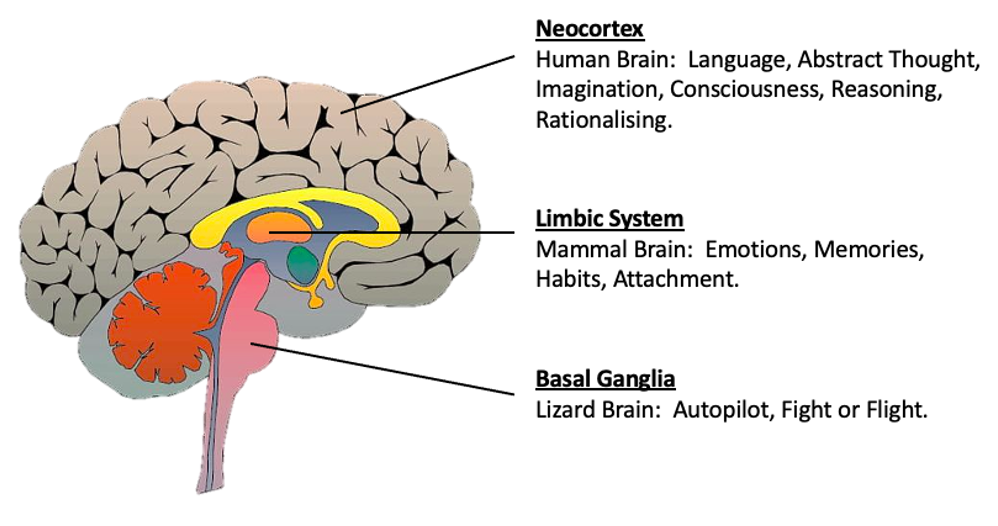
Breaking old, bad habits and forming new ones is an embodiment of the transformative journey of growth. The triune brain model can help us align these ideas, shedding light on this process. Within this model we have three regions of the brain: the “lizard brain” (Basal Ganglia) housing habitual behaviours, the “mammal brain” (Limbic System) handles emotions and motivations, and the “human brain” (Neocortex) governs rational thinking.
By aligning our actions with our “why”, our purpose and values, we channel our emotional and motivational aspects of change (within the mammal brain) to combat the ingrained habits (within the lizard brain). This can then empower us to override the pull of these old, bad habits, sculpting novel neural pathways, replacing obsolete routines with constructive behaviours intricately linked to our growth-orientated identity. This synergy empowers us to forge new neural pathways, replacing detrimental routines with positive behaviours that align with our growth-driven identity, our growth mindset.
In the realm of change and growth, it is not enough to merely know “what” and “how”, this is held only in the rational part of the brain, the human brain. It is important to accept that the “why” is the orchestrator, harmonising our motivations and actions. In this sense, the “why” held within the mammal brain acts as the nucleus that catalyses transformation, reprogramming the lizard brain where habits are held.
As Sinek beautifully articulates, “People don’t buy what you do; they buy why you do it.” When we internalise our purpose and values, weaving them into our identity, we pave the way for sustainable change. By applying the insights from “Atomic Habits” and “Start with Why”, we embark on a profound journey of change. This journey bridges the gap between intention and action, harnesses the power of habits, and drives us towards growth that is deeply rooted in our purpose.
6. How can we utilise this to achieve effective growth?
Growth within leadership involves the following 8 areas.
- 1 – Skill Enhancement: Developing and refining the specific skills and competencies required for effective leadership, such as communication, decision-making, problem-solving, conflict resolution, and strategic thinking.
- 2 – Continuous Learning: Embracing a mindset of lifelong learning, staying curious, and actively seeking opportunities to acquire new knowledge and stay updated on industry trends and best practices.
- 3 – Adaptability: Being open to change, embracing challenges, and demonstrating agility in navigating evolving business landscapes.
- 4 – Self-Reflection: Engaging in introspection to identify strengths, weaknesses, and areas for improvement, and taking proactive steps to address these areas.
- 5 – Expanding Perspectives: Actively seeking diverse experiences, collaborating with a variety of individuals, and valuing different viewpoints to broaden one’s understanding and approach to leadership.
- 6 – Mentorship and Coaching: Seeking guidance and mentorship from experiences leaders, as well as providing mentorship to others, to facilitate mutual growth and development.
- 7 – Embracing Feedback: Welcoming constructive feedback and using it as a tool for self-improvement, rather than viewing it as criticism.
- 8 – Personal Transformation: Cultivating a growth mindset that sees challenges as opportunities for development, and embracing personal growth that extends beyond the professional realm.
Coming to the end of our exploration of growth, mastery and motivation, we find ourselves standing at the precipice of a profound journey. One that promises self-discovery, improved leadership acumen and transformative growth. The insights we have gained through our journey has led us through a roadmap, central to this is the recognition that both change and growth emanate from within, grounded in the essence of who you are.
If we embrace identity-based habits, we are able to rewrite our actions and redefine who we are. We can travel a path where our “why”, grounded within our inner beliefs and values, converges with our very being, who we actually are. This harmonious fusion ignites a fire of purpose that fuels our motivation, exhibited in our actions and shapes our leadership journey. In essence, a clear “why” serves as the North Star that guides our quest for leadership mastery.
Intrinsic motivation, a source of unwavering drive, propels us forward on this journey of growth. With roots anchored in the depths of our purpose, we’re equipped to overcome challenges, cultivate resilience, and venture into the realm of our zone of proximal development with confidence. This symbiotic relationship between our “why” and intrinsic motivation creates a symphony of determination, pulling us closer to the elusive flow state, a realm of immersive focus and boundless creativity.
The concept of flow is where the culmination of our efforts resides. As we master our skills, guided by the principles of deliberate practice and feedback loops, we stand on the threshold of this heightened state of consciousness. A growth mindset, interwoven with the understanding that growth requires effort and persistence, propelling us to continuously push our boundaries. The flow state becomes both the destination and the vehicle of our journey, a space where our purpose, motivation, and skill intertwine, driving our leadership acumen to ever-increasing levels.
So, as you embark on a journey that is uniquely yours, the destination is clear: a realm of leadership mastery, personal growth, and transformative impact. The road may twist and turn, presenting challenges and opportunities, but the compass is set by your “why”. Embrace the growth mindset, harness intrinsic motivation, and strive for the flow state, for within these facets lies the enigma of growth and the reward of true leadership excellence. As you forge ahead, remember that your journey is not about reaching the destination, for that may never come, but instead it is about the continued and profound growth and transformation that unfold along the way.
Christopher Waters
Founder of LAMDA Solutions
For information about how LAMDA Solutions can help you on this journey, please get in contact with us, or explore more about the LAMDA Way and our L-E-A-D-E-R Process.