Following on from the blog last week, I am once again reflecting on my background within Physics. Having had a discussion last week around the blog post I had written on how Newton’s laws could be applied to leadership, I was challenged to think on the concept of entropy and how this could be applied to leadership.

Having considered this for a few minutes, I found a parallel and started thinking wider into the laws of thermodynamics and how they can be aligned with leadership. This post is therefore a summary of my thoughts on this.
The Zeroth Law of Thermodynamics
Within Physics this law is used to determine the concept of temperature and defines thermal equilibrium.
Firstly, we must get an understanding of thermal energy and temperature in terms of Physics to find an analogy within organisations. Thermal energy is a form of energy which a system can have collectively (it is the sum of this collective energy within the system or object) while temperature is a measure of the average kinetic energy of the particles which make up the system (the average amount of energy each particle has which makes it move).
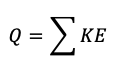
Where Q is the heat and the right-hand side means sum of the kinetic energies of the particles.
These two are different and this is why we have the zeroth law; a law so important that even though it was defined last, it was placed first within this order.
We can now use this to understand the concept of thermal equilibrium. If we were to have two objects, A and B, placed next to each other and isolated from the surroundings, they would tend towards the same measure of thermal energy. In other words, they would reach a state whereby the net flow of thermal energy from one object to the other ( ) is matched by an equal flow in the opposite direction (
 ).
).
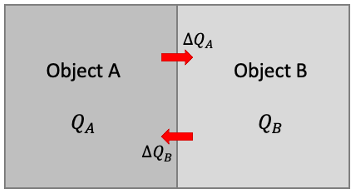
If we were then to take one of the objects, A, and place it next to another object, C, and they were to be in thermal equilibrium. We would be able to say that objects B and C must also be at thermal equilibrium too. This happens everywhere around us, the desk you are sitting at and the air are likely to be in thermal equilibrium providing there has been a suitable amount of time for them to reach this state. The air would also likely be in thermal equilibrium with the door of the cupboard in the corner. The cupboard door and the desk have not touched each other, however as they have a third object which they are each in thermal equilibriumwith, the air, they must be in thermal equilibrium with each other.
The Zeroth Law In our context?
Summary of analogous terms:
- Temperature – Motivation, Determination and Drive of Workers at the Organisation.
- Kinetic Energy – The act of working of the Workers at the Organisation.
- Thermal (Internal) Energy – Productivity of Groups, Teams, Functions, or the entire Organisation.
- Thermal Equilibrium – A state of successful collaboration between Groups, Teams, Functions or Organisations.
If we start from the individual and build outwards, we can see how these correlate well. When the individual workers within an organisation are highly motivated and driven, then more work is likely to achieved and as such the productivity of their group or even the organisation as a whole is higher. When we look at individual groups or functions within an organisation, only when they match each other for productivity can there be a successful measure of collaboration. If there is one function which is lower in productivity, then a bottleneck is created, forming a backlog and dysfunctionality within the organisation.
This is not yet a fully functioning analogy, as we need to consider a few other elements to fully draw together a complete picture.
The First Law of Thermodynamics
Within Physics this law is commonly stated as the conservation of energy, although the full law is more fundamental than this. So, what is principle of the conservation of energy.
Energy cannot be created or destroyed, only transferred from one form to another.
Within the first law, we consider systems as having internal energy defined by the following equation.
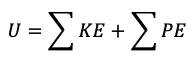
This may look complicated, however when we break it down it should make complete sense. Before we do this, something in Physics which must be done is to define a reference point; a zero point. This is Absolute Zero. Absolute zero is a theoretical state at which the kinetic energy, or movement, of the articles is zero.
All the particles around us are in constant motion; within the solid objects there are constant “oscillations” and “vibrations” of the unimaginably small particles which it is made of, within your glass or cup, the particles within the liquid are in constant flow over each other, while in the air we breathe the particles are zooming about freely.
Absolute zero within Physics is defined as being -273.15oC or -460oF, the lowest possible temperate. As all particles in the Universe move, there are no places within the Universe where this temperature is reached.
The internal energy, U, of the system is then the sum of the kinetic energies of the particles within this system and the sum of something called the potential energies of the particles within this system. The easiest way to imagine this is to consider potential energy as being a measure of how far away from being free a particle is; its degree of freedom. The only particles around you which are “free” are those within the gas which makes up the air, therefore those in your cup or glass are some measure away from being free. They can however flow over each other and therefore have some form of freedom, while those in the solid desk in front of you can only vibrate and are therefore far from being free, they are in fact trapped within the structure of the solid.
I often liken this to being trapped within a well, if we were to say freedom was walking around on the surface of the Earth, then being trapped within a well is some way from being free. In fact, it would require you to climb up and out of the well to be free. This would take energy to do!

In Physics we take this measure of energy and call this potential energy; in order to become free of the well you must climb up against the force of gravity. Within the solid of the desk there are strong bonds, or forces, between the particles which have trapped them. To become free these must be overcome, and would therefore reduce the amount of energy the particles have to use when they become free, as such this potential energy is a negative amount of energy. For example, a potential energy of -10J would tell us that it would take 10J of energy to become free!
So how can particles within a solid become free? This is where our second equation comes in. You need to change the internal energy of the system;  . This change can go in to either pot; the kinetic energies of the particles (the temperature of the system) or the potential energies of the particles (the degree of freedom).
Each substance is unique in this way, as their bonds and their particles are different. This leads to graphs such as the one below.
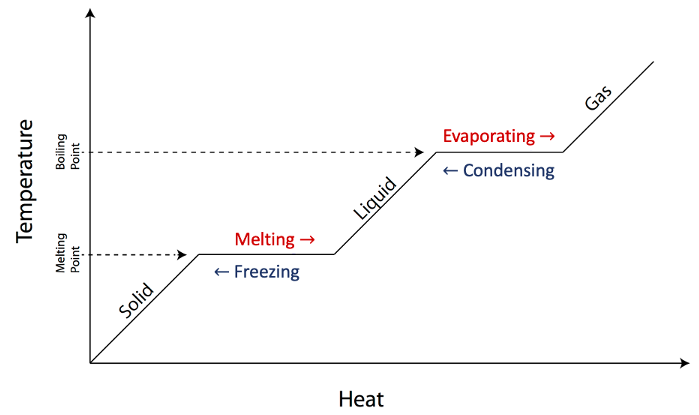
Within this heating graph, we see points at which the temperature increases due to the increase in kinetic energies of the particles, however we then see plateaus where there is no increase in kinetic energies and instead there is an increase in potential energies as they gain a degree of freedom during a phase change.
The mechanisms by which the internal energy can change is threefold and defined in the following equation.

All this tells us is that, in order to positively change the internal energy (add to the internal energy of a system) we must either add head (Q), through work (W) or add more particles ( ).
).
Work within the context of Physics is defined as the transfer of energy through the application of a force. The direction of the force will therefore determine the direction of the energy transfer; either from the system outwards or from the surroundings inwards. Doing work on the system itself is defined as the opposite of the system doing work, hence the negative sign in the equation above.
The First Law In our context?
Summary of analogous terms:
- Absolute Zero – Our reference state for the organisation; the productivity before it existed.
- Bond – The level of control over the work, processes and procedures maintained by those in charge (A Measure of Management).
- Potential Energy – The measure of potential of the Workers at the Organisation (between their current level and the maximum level they could reach).
- Degree of Freedom – The level of empowerment bestowed upon the Workers at the Organisation by those in charge.
- Work – The amount of challenge provided by those in charge to the Workers at the Organisation.
- Force – The avenues of influence used by those in charge, such as leadership techniques, as well as external driving factors such as the financial or political landscape, etc.
We are starting to build a fuller picture of the analogy between the two and therefore the leadership lessons which can be drawn from these fundamental principles within Physics. Let’s see where the second and third law of thermodynamics takes us before we draw them out.
The Second Law of Thermodynamics
Within Physics this law is commonly stated as the law of entropy. So, what actually is entropy?
Entropy is something which we take for granted every day, it is the reason our hot cup of coffee cools down over time, it is the reason that everything which is built, without continued intervention, will eventually crumble and fall into disrepute. But how in Physics is it defined?
Entropy in Physics is associated with a state of disorder, randomness or uncertainty. When teaching entropy, I tended to simplify the tendency of the Universe going from low to high entropy in the following way;
- Particles naturally spread out.
- Energy naturally dissipates.
- The Universe tends towards a state with more, lower energy particles.
Within this is a fundamental law of Physics; in order to decrease the entropy of a system it requires the application of a force and work to be done on the system.
The Second Law In our context?
Summary so far of analogous terms:
- Entropy – A measure of disorder or misalignment.
We can easily understand this analogous implication; without the application of leadership techniques, empowering and challenging individuals, there will be an increase in misalignment. Energy will get dissipated in no-productive ways, with a decrease in productivity an overall a reduction in the effectiveness of the organisation. In essence a fundamental leadership rule rises out of this.
The productivity of an organisation rises and falls on the effectiveness of an organisation’s leadership!
We have one more law of thermodynamics to discuss before we can draw together everything we have uncovered and reveal the leadership landscape which we have developed through this exploration.
The Third Law of Thermodynamics
Within Physics this law is sometimes called the law of absolute zero. This ties together our concept of absolute zero with entropy. In essence this law is very simple, it tells us that all systems, regardless of what they are, will have a constant, near zero value of entropy at absolute zero. In other words, at absolute zero, the system is highly structured.
As we know from the second law, the entropy of systems always increases naturally, and therefore in order to achieve this an incredibly large amount of work must have been done on the system over an incredibly large amount of time in order to fight against the natural order of things.
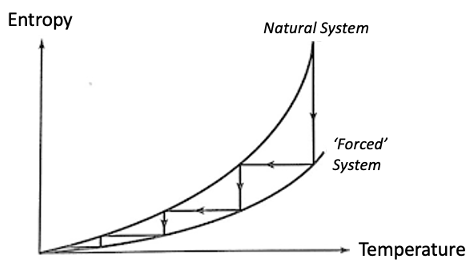
In the graph you can see that if we were to try and increase the order of the system, it would lower the temperature of the system. This has been attempted in multiple ways in Physics experiments, in order to achieve absolute zero. By forcing together particles under high pressure for example, you can decrease the entropy of the system, as a result the system reduces in temperature (this is why a deodorant can under high pressure feels cold).
However, you can see that it would take an almost infinite number of steps (the arrows) to reach zero!
The Third Law In our context?
This law introduces no new analogous terms; however, it provides us with an important implication. Forcing too much order, imposing too much challenge which is unassailable, whilst maintaining too much control through strong, overbearing management, (which are all factors in the control of those in charge) will lead to a reduction in the motivation, determination, and drive of the workers at the organisation.
The Leadership Landscape which this Unveils:
There are several key factors which arise through this analogy and we shall explore these in detail here:
- The Interplay between Energy and Productivity: just as the transfer of energy dictates the behaviour of a system in thermodynamics, we can see that motivation, determination and drive influences the productivity of the individuals and therefore the collective efficiency of the organisation. We can see therefore that only when this motivation, determination and drive is harnessed effectively by the organisation can the true potential of the organisation be reached.
- Harmony in Energy Dynamics: in a similar vein, the motivation, determination and drive of individuals, groups and the organisation as a whole also thrives based on the balanced interplay between challenge, empowerment and control. When these three drivers are in-tune with the needs of the individuals, they reach a harmony which maximises their growth, and the potential of the organisation can be reached.
- Leadership as a Driving Force: leadership approaches, empowerment, and the level of challenge provision by those in charge at all levels within the organisation act as the driving forces that influence the growth of individuals towards their potential. Leadership significantly impacts the motivation and drive of workers within an organisation, influencing their individual and collective productivity levels. It is therefore vital that there is effective leadership as this can align all these factors, which ultimately leads to increased productivity and alignment.
- Optimising Entropy for Growth: effectively managing disorder within an organisation by employing appropriate leadership strategies provides alignment, clearly defined structures and leads to individual growth, increased productivity and effectiveness. In essence, there is an optimised level of order within an organisation; too much freedom is as dangerous to productivity as too much structure.
- Balancing Control and Disorder: as we know there is a fine balance required here, as too much control or excessive order can stifle the motivation and drive of workers in an organisation. However, an appropriate balance is needed between the use of management strategies to maintain control and individual empowerment, only with clear processes and structures in place can a harmonious and productive environment evolve.
- Energy Control and Work Potential: the effective application of both challenge and control by leaders defines the limits and growth of a workforce. Balancing this empowers individuals and optimises their productivity and elevates them towards their true potential. A leader’s role is to channel the potential of the workforce, fostering an environment for continuous evolution and growth.
- The Importance of Collaboration: successful collaboration, akin to thermal equilibrium, is achieved when different groups or functions within an organisation match in productivity. Misalignments create bottlenecks, leading to dysfunctionality. Too much focus on one area of an organisation can also lead to dysfunctionality, as this may lead to one highly motivated group or function. Consistency is key, as this can be a demotivating factor for other groups or functions. This requires effective leadership practices to ensure productivity is maximised; through the three routes of:
- Adding clarity or redefining the task needed to impact the individual’s ability to do the task.
- Adding challenge or providing training to increase their ability to do the task.
- Providing support or hiring additional members to the team to ensure they can complete the task.
- Equilibrium in Empowerment: organisational equilibrium is achieved when different groups or functions are equally empowered and aligned, this enables seamless collaboration and overall increased productivity.
- Leadership as the Determinant of Organisational Effectiveness: The effectiveness of an organisation is intrinsically linked to the effectiveness of its leadership. Effective application of leadership practices, along with balancing empowerment and challenge, is vital to maintaining and enhancing productivity.
- Leadership for Organisational Change: just like a system goes through a phase change, organisations also require shifts, such as evolutions or organisational changes. The readiness and driver behind this arise through the continued application of effective leadership strategies.
We shall call this inter-connectedness which has arisen through this exploration of thermodynamics and analogising it to organisational structure and leadership ‘Organisation Resonance Theory’.
The three guiding principles which underpin this new theory are;
- Adaptive Resonance: Understanding and resonating with the adaptive nature of an organisation to various internal and external changes is crucial. Leaders must adapt their strategies to maintain alignment and productivity in fluctuating conditions. Leadership is the buffer between the outside world and the internal functionality of an organisation. A leader’s main purpose is to build and maintain strong relationships between themselves and those in their charge, when this is achieved they are bestowed the power of influence. With this influence, they can have a direct impact on the motivation, determination and drive of those in their charge. This can impact both the productivity of the organisation as well as the level of resilience it has to external influences.
- Fluidity in Control: Leaders need to understand the necessity of adaptable control mechanisms, allowing for a fluid balance between control, empowerment and challenge. When they understand their ability to adjust these in response to both the individuals within their charge and the organisational requirements and goals, their teams will be able to achieve incredible results. In essence, this is about growing a culture of continued learning, growth and challenge. The best way of doing this is to embrace it equally themselves by inviting feedback, challenges and being open to new ideas and approaches within a clearly communicated direction.
- Psychological Thermodynamics: Recognising the psychological underpinnings of the workforce’s motivation and determination is key. This involves more than just the factors within work and instead acknowledging the vital importance of those outside the workplace. It is key that leaders engage in one-to-one discussions with those in their charge, leading the whole individual. An adaptive coaching-mentoring approach provides an environment for both psychological safety as well as the environment for challenge, growth, and collaboration. Leaders who understand this and embrace this approach can leverage these psychological dynamics to significantly impact the growth of those in their charge and maximise organisational effectiveness.
A Summary of ‘Organisation Resonance Theory’
This unique model establishes an intricate relationship between thermodynamic principles and the dynamics of leadership, offering a fresh perspective on how an organisation functions and the pivotal role of effective leadership within it.
At its core, this theory accentuates the fundamental interplay of energy, akin to the motivation, determination, and drive of individuals within an organisation. Similar to thermodynamic systems, where energy transformations dictate behaviours, the motivation and determination of workers significantly impact productivity, ultimately shaping the efficiency of the entire organisation.
A key revelation in this model is the emphasis on managing entropy, which symbolises disorder or misalignment within an organisation. Just as reducing entropy leads to increased efficiency in thermodynamics, the reduction of disorder within an organisational structure is vital for productivity. Effective leadership includes the minimising disorder and optimising the alignment of efforts within collaboration, much like maintaining equilibrium in a thermodynamic system.
Moreover, this model positions leadership as a catalyst for different ‘energy states’ within an organisation. Leadership techniques, empowerment, and challenge provision play a pivotal role in determining the growth and effectiveness of the workforce. Balancing control and empowerment emerges as a critical factor, ensuring a harmonised and efficient working environment.
The model accentuates the delicate balance between control and empowerment, underscoring the necessity for leaders to manage work processes while empowering individuals to optimise productivity. Furthermore, it introduces the psychological dynamics of the workforce’s motivation and determination, and the impact that the approach to leadership and management can have on this. With the redirection of energy away from productive efforts, and a dwindling of motivation and determination, resulting from high levels of management and control. Understanding and leveraging these psychological factors become essential for impactful leadership in enhancing organisational effectiveness.
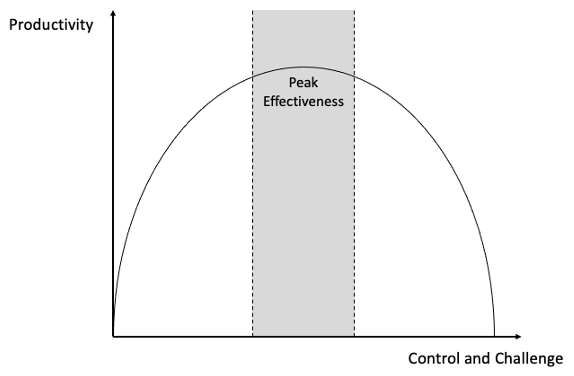
In the realm of organisational dynamics, the concept of “flow” emerges as a crucial aspect within the framework of Organisation Resonance Theory. Just as particles in a liquid exhibit a balanced and adaptive movement, the model recognises the significance of achieving a similar state within an organisation. The notion of flow encapsulates the delicate equilibrium between control and freedom, akin to the balance between a solid’s rigidity due to the strong bonds the particles experience and a gas’s free yet random movement.
Too much rigidity and control, with low levels of empowerment, resembling a solid in thermodynamics, results in an organisation that is inflexible, resistant to change, and devoid of creativity and adaptability. This type of organisation has a low level of resilience in the face of strong external factors forcing change; this can lead to fracturing and complete structural failure under extreme pressures. In this scenario, excessive control impedes the organic evolution and growth necessary for an organisation to thrive in dynamic environments.
Similarly, an excess of freedom resembles a gas in thermodynamics. This comes with low levels of control and an absence of structural processes and frameworks resulting from poorly implemented management techniques. This may see high levels of empowerment; however, it will lead to a lack of structure, direction, and coherence. Over time, efforts will dissipate, and motivation will dwindle, because when individuals operate without guidance or a sense of purpose, the organisational landscape becomes chaotic, lacking alignment and direction.
Drawing from the analogy of flow within a liquid, effective leadership operates within the fluidity, creating an environment where control is balanced with a degree of freedom. It involves guiding the workforce without stifling creativity and innovation. By providing effective levels of empowerment, alongside support and challenge, motivation can peak, and a state of flow can be achieved by individuals within the organisation which will see individual growth as well as maximising organisational productivity.
Much like the fluid nature of a liquid, there’s movement, adaptability, and a sense of direction within the organisation. For example, the liquid within a bottle is free to flow when the bottle is tipped in a direction, the particles all move in the same direction, for example into a glass, and they successfully take the shape of the bottom of the container. This is analogous to a leader implementing a change; although everyone may take their own path along the direction of travel, they are free and able to adapt to the change. This allows for a continuous, organic adaptation to changing circumstances, fostering an environment conducive to productivity and innovation.
In this context, Organisation Resonance Theory underscores the necessity for leaders to navigate this balance, ensuring that the workforce operates with a structured yet adaptable environment. Effective leadership fosters an environment where individuals are empowered but guided, using an adaptable approach and harnessing the power of both coaching and mentoring, allowing for the organic evolution necessary for an organisation’s success.
Hence, this model emphasises that effective leadership isn’t about rigid control or absolute freedom but rather about steering the workforce in a manner that facilitates a fluid, purposeful movement – a state of “flow” that mimics the adaptable nature of particles in a liquid. Achieving this state is essential for a dynamic and responsive organisational structure, reflecting the intricate balance between control and freedom that drives productivity and success.
In essence, Organisation Resonance Theory pioneers a novel approach, shedding light on unique facets such as energy transfer, entropy management, and the psychological underpinnings of an organisation’s workforce. By integrating thermodynamic principles into the landscape of leadership and organisational dynamics, this model provides the potential for a comprehensive understanding that surpasses traditional leadership models, offering a holistic and innovative perspective on achieving organisational success through effective leadership strategies.
Christopher Waters
Founder of LAMDA Solutions
For information about how LAMDA Solutions can help you on this journey, please get in contact with us, or explore more about the LAMDA Way.
A true Tour de Force Chris, and creativity at its best. ‘Organisation Resonance Theory’ has emerged from the ether. I wonder what Isaac would make of it!